By Carlos Jordaky – The Jordakywith editing and adaptation by the Gaming365 newsroom
The financial market starts the week confirming a movement that can no longer be treated as an exception: the global geopolitical crisis has established itself as a permanent part of the economic environment.
It is no longer an isolated shock or a one-off event, but a continuous accumulation of simultaneous tensions. Historically, this type of scenario increases volatilityreduces predictability and forces investors to rethink long-term strategies.
The United States, the Middle East, Eastern Europe and disputes in strategic regions continue to shape the mood of the markets at the beginning of 2026 — not as noise, but as a structural factor.
Geopolitics: when the crisis stops being noise and becomes the rule
The main characteristic of the current scenario is its multifocal nature. Today, there is no single dominant epicenter of instability, but several points of tension that reinforce each other:
- United States they continue to use tariffs, sanctions and strategic influence as central foreign policy instruments, increasing global institutional risk.
- Russia x Ukraine remains in a prolonged conflict, with direct impacts on energy, food and European logistics.
- Middle Eastespecially on the Iran-USA axis, remains on investors’ radar, keeping the risk on energy routes and supply chains high.
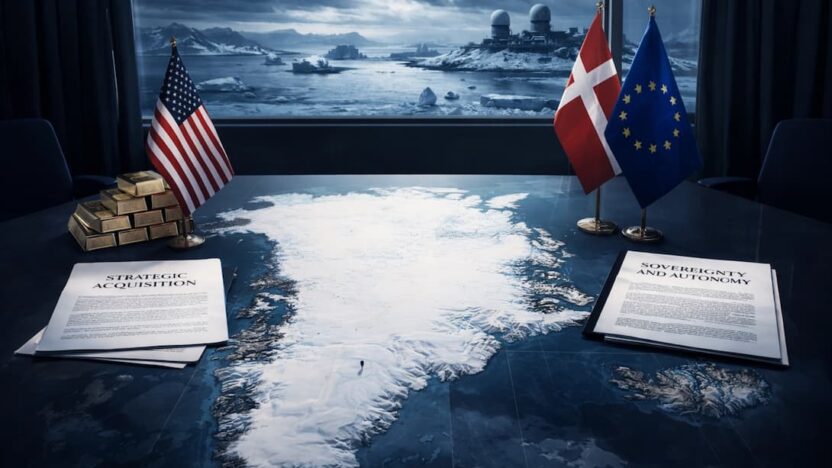
- Strategic regionslike the Arctic, are beginning to enter the geopolitical tableau, adding a new layer of instability between great powers.
👉 The market no longer prices quick resolution. He prices coexistence with risk.
Energy and commodities: the thermometer of global instability
Oil starts the week without explosive movements, but carries an implicit geopolitical premium. Sanctions, regional disputes and risks of disruption keep prices supported, even when the news appears neutral.
Gold continues to trade at high levels, reflecting:
- loss of institutional predictability,
- global political tensions,
- search for reserve assets.
Silver follows this movement, with even more volatility, adding a financial protection function to industrial demand.
👉 When precious metals remain firm for several trading sessionsthe market is hedging — not speculating.
Global stock markets: selective resilience, not euphoria
International stock markets start the week on a mixed note, but without signs of panic. The observed pattern remains consistent:
- sectors linked to energy, commodities, defense and value show greater resilience;
- Assets dependent on distant growth, abundant liquidity or very low interest rates face greater instability.
It is not a euphoric market. It’s a market judicious and defensive.
Exchange rate and interest: an unstable balance
The dollar remains highly sensitive to any geopolitical headlines. In scenarios like the current one, it quickly oscillates between:
- currency under pressure due to expectations of lower interest rates;
- safe haven asset in times of escalating risk.
Global interest curves reflect this permanent tension between economic slowdown and elevated political risk.
How capital is reacting to the global crisis
The behavior of investors at the beginning of 2026 reveals clear trends:
1️⃣ International diversification is no longer a differentiator and has become a basic pillar
2️⃣ Real assets and commodities gained structural weight
3️⃣ Liquidity is once again a strategic asset
4️⃣ Protection is no longer a cost and has become a necessity
5️⃣ Narratives lost space for fundamentals
👉 The investor who goes through this scenario well is not the most aggressive — he is the most prepared.
Brazil: increased attention at the beginning of the week
The Brazilian market starts the week:
- sensitive to the external scenario,
- with the exchange rate reacting to global flows,
- and long interest rates attentive to the behavior of energy and international inflation.
Fixed income remains a defensive basis, while the stock market requires careful macro reading and more careful asset selection.
The investor’s new reality in 2026
The central point is not to predict what the next conflict will be — but to understand that geopolitical risk has become structural.
Investing today is not just about seeking a return. It’s managing exposure to extreme scenarios.
Those who think about investing maturely seek context inside and outside the country. Investing abroad is no longer a luxury — became a strategic decision for those looking for:
- property security,
- financial freedom,
- sustainable growth.
Conclusion
January 19, 2026 begins with the market accepting a clear reality: geopolitical risk is here to stay.
In environments like this, return without protection is an illusion.
Information, strategy and diversification continue to be the true differentiators.
Fonte: Gaming365 – Brasil