
A New Era in Japanese Politics
Japan is experiencing a moment of political and economic transformation, with the prime minister Sanae Takaichi assuming a central role. Elected in October 2025, Takaichi became the first woman to lead the country, marking an inflection point in Japanese political history. His rise to power occurred amid a reconfiguration of the political scenario, with the breakup of the traditional alliance between the Liberal Democratic Party (LDP) and Komeito, which had dominated the government for decades.
The new leadership of Takaichi not only challenges established political norms, but also offers a new direction for the country. With a popularity rating of around 70% in the first months of government, she took the bold decision to dissolve the House of Representatives and call early elections for February 2026. This decision aims to consolidate her power and ensure broader legislative support for her policies, but it also carries the risk of weakening her government if her coalition does not achieve the necessary majority.
Economic Challenges and Growth Strategy
The Japanese economy faces significant challenges, including one of the highest public debts in the developed world, an aging population and historically low economic growth. To address these problems, Takaichi proposed an ambitious agenda that combines fiscal expansion, incentives for strategic sectors and strengthening national security.
Among his promises are increasing consumption and income without raising taxes, cuts in the provisional fuel tax and tax incentives for sectors such as technology, defense, energy and infrastructure. Experts believe that despite his decisive style and focus on reforms, the effectiveness of these measures will depend on his ability to form broader parliamentary coalitions and balance fiscal stimulus with debt sustainability.
Financial Market Reactions
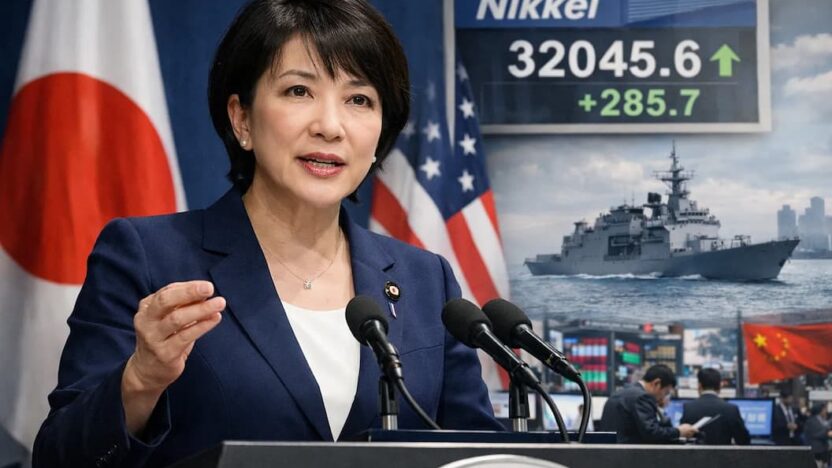
You financial markets have responded positively to the expectations surrounding Takaichi’s leadership. The Nikkei 225 index reached all-time highs, driven by the prospect of pro-growth policies and fiscal stimulus. This optimism reflects the hope of an economic revival, similar to what was observed during the ‘Abenomics’ era.
However, economists warn that the global environment of higher interest rates and Japan’s fiscal constraints could make it difficult to maintain this momentum. The Japanese currency, the yen, has remained relatively stable as the market continues to assess the balance between expansionary fiscal policies and possible monetary normalization by the Bank of Japan.
Geopolitics and International Relations
On the international scene, Takaichi has adopted a more assertive stance, especially towards China. Its strategy includes strengthening the alliance with the United States, considered crucial for regional security in the Indo-Pacific. This approach also involves greater coordination with countries such as South Korea, Australia and India in multilateral forums.
Furthermore, Takaichi plans to increase defense spending to around 2% of GDP, aligning with global trend of ‘strategic rearmament’ in response to regional tensions. This policy reflects Japan’s intention to take a more active role in the geopolitical dynamics of the Indo-Pacific, reinforcing its position as a key actor in regional security.
The Future of Japan under Takaichi’s Leadership
The Japan of 2026 is at a critical crossroads, with significant changes to its politics, economy and geopolitics. Sanae Takaichi emerges as a central figure in this scenario of profound transformations. It represents both the hope of vigorous reforms and the risks associated with a delicate fiscal and political framework.
The response of the Japanese electorate to the early elections and how markets react to these results will have a significant impact not only on Japan’s economic future, but also on its role on the global stage. Takaichi’s leadership will be tested by his ability to implement his policies and navigate the complex internal and external dynamics that shape contemporary Japan.
How the Japanese electorate responds to its electoral call and how markets anticipate or reinterpret such results will define not only the direction of the Japanese economy — but also Japan’s impact on the changing global landscape.
Do you want to understand how to access international assets linked to this new global investment axis?
Fonte: Gaming365 – Brasil