
Sportradar identified a significant increase in suspected cases of match-fixing in North and Central America in 2025, even with a slight global drop in flagged matches.
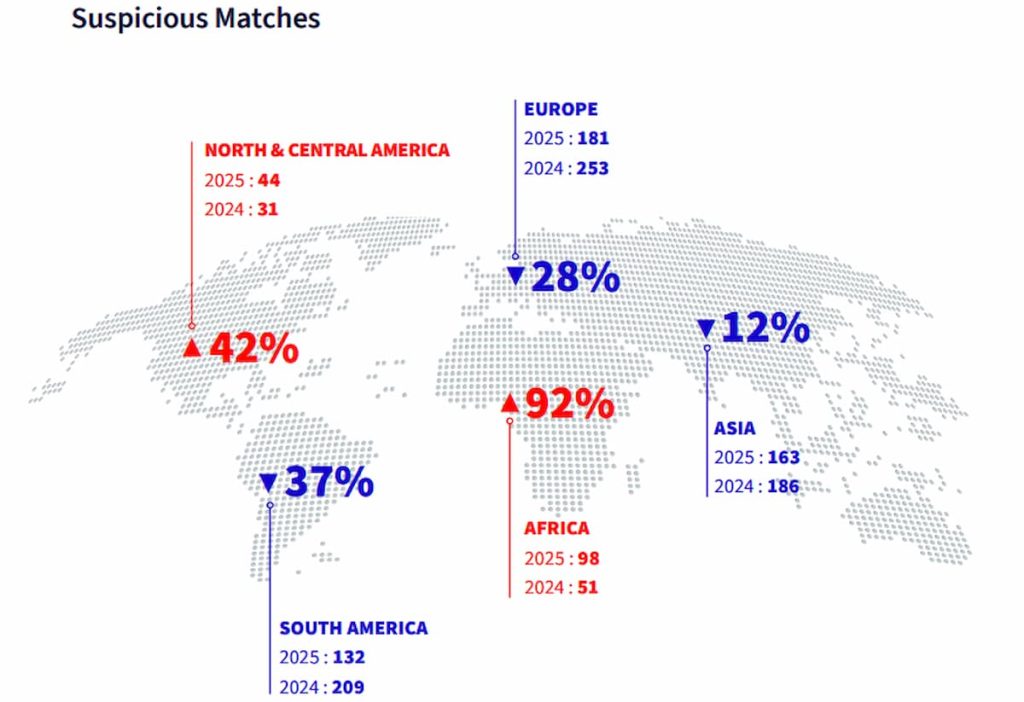
According to the new Integrity Report of the company, suspicious games in the world fell 1% compared to 2024. However, North and Central America recorded one of the biggest proportional growth on the planet.
Access the full report here: https://goto.sportradar.com/Sportradar_Integrity_in_Action_2025.pdf
Global numbers of match fixing in 2025
Sportradar monitored more than 1 million sporting events in 12 modalities and 94 countries.
They were 1,116 suspicious departures in total.
Distribution by region:
- North and Central America: 84 suspicious departures (almost twice as many as in 2024)
- Europe: 385 cases (down from 66)
- South America: 183 cases (down from 64)
- Asia: 351 cases (slight increase)
- Africa: 113 cases (relevant increase)
According to the company, the increase outside Europe indicates a “gradual diversification of manipulation activity”, which was previously more concentrated on the European continent.
Recent cases reinforce alert in the USA
The report highlights that growth in North America coincides with high-profile investigations in the United States.
Among recent cases:
- 📌 College basketball (NCAA): players reportedly accepted bribes to manipulate performance in dozens of games.
- 📌 NBA: point guard Terry Rozier was investigated for allegedly leaving a game strategically, impacting bets like “prop bet”.
- 📌 MLB: Cleveland Guardians players have been accused of manipulating pitches to favor specific betting markets.
These cases show how integrity risks are increasingly linked to the growth of regulated sports betting markets.
Artificial intelligence in the fight against manipulation
Sportradar has been reinforcing its monitoring system with the UFDS AI (Universal Fraud Detection System with Artificial Intelligence).
In 2025:
- Suspicious games identified by AI jumped 432 to 682
- The system began to detect more subtle patterns and niche markets
The company also launched the Sportradar Integrity Exchange (SIE)a platform that allows operators to share information in real time to reinforce prevention.
Furthermore:
- More than 34 thousand people received training in sports integrity (up 25%)
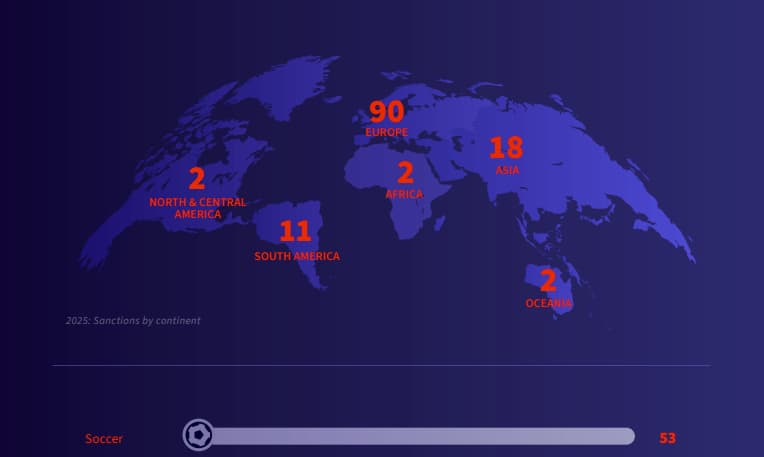
- 125 sanctions were applied in seven sports
⚠️ New tactics from manipulators
The report highlights changes in the profile of those involved in manipulation:
- Use of cryptocurrencies for illicit payments
- Communication via Telegram
- Action of “lone wolves”, with more fragmented connections
- Resale of insider information
- Distribution of bets across multiple accounts to avoid detection
These strategies make tracking more complex and require advanced monitoring technology.
Which sports are most affected?
Football remains the main target:
- Soccer: 618 suspected cases
- Basketball: 233 cases
- Tennis: 78 cases
Trends in manipulated markets
Soccer:
- 77% of cases involved live betting
- 71% occurred in the first half
- 41% involved combined bottom line markets
Basketball:
- 49% linked to “over/under” markets (total points)
- 35% related to spreads (handicap)
This indicates that manipulators are focusing more on specific markets than necessarily on the final result of the match.
What does this mean for Brazil?
With the Brazilian betting market regulated and expanding, the international scenario serves as a warning.
The growth of sports betting tends to:
- Increase the financial volume circulating
- Attract greater attention from criminal networks
- Require robust monitoring systems
For Brazil, the main challenges will be:
- Integration between operators and sports entities
- Real-time monitoring
- Cooperation with authorities
- Investment in education about integrity
Conclusion
Although global numbers indicate a slight improvement, the advance of manipulation in North America shows how criminal networks are quickly adapting to the expansion of regulated betting.
With technology evolving and new markets emerging, pressure on leagues, operators and regulators is likely to increase.
Sports integrity becomes not just a regulatory issue, but a strategic factor for the sustainability of the sport. betting sector in the long term.
Fonte: Gaming365 – Brasil